
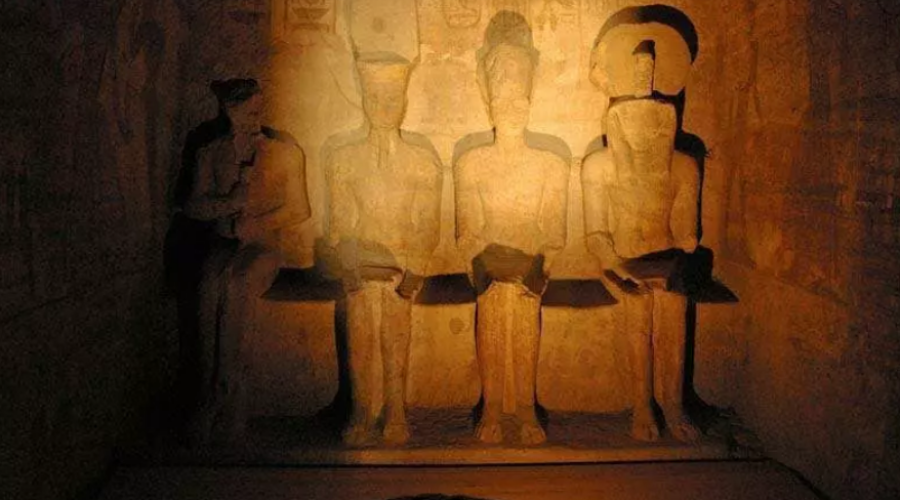
The phenomenon of the sun’s rays falling on the Holy of Holies of the Temple of King Ramses II in Abu Simbel on October 22

In celebration of the phenomenon of the sun’s alignment with the Holy of Holies of the Temple of King Ramses II in Abu Simbel on October 22, learn the story of saving the Abu Simbel temples in the sixties of the last century, the most famous archaeological temples in Egypt.
The sun’s alignment with the Abu Simbel Temple in Aswan is a unique phenomenon that demonstrates the ingenuity of the ancient Egyptians in the field of astronomy and architecture.
This phenomenon used to occur on October 21 and February 21 of each year, and after the temple was moved to a hill 66 meters high, the phenomenon was delayed by 24 hours to become October 22 and February 22 of each year.
The sun’s rays seep into the temple during the alignment, reaching the Holy of Holies, to shine their light for a period ranging between 20 and 25 minutes, on the statue of King Ramses II and next to him the statues of the gods Ra, Horakhty, and Amun, as well as the god Ptah, whose face the sun does not shine perpendicularly on, as the ancient Egyptians considered him the god of darkness.
The phenomenon was discovered in 1874, when explorer Amelia Edwards and her team observed and recorded the phenomenon in her 1899 book, A Thousand Miles Up the Nile.
The Abu Simbel temples are part of the UNESCO World Heritage Sites and were carved as a permanent monument to King Ramses II and Queen Nefertari, celebrating his victory at the Battle of Kadesh.


 All Right Reseved